Hurun Top 100 US Enterprises in China 2026
Hurun Research Institute today released the “Hurun Top 100 US Enterprises in China 2026”. This report aims to track the performance of U.S. companies in the Chinese market. This is the third year of the report.
 Hurun releases report on the Top 100 US Enterprises in China 2026
Hurun US 100 China Revenues US$362.2 billion, up 1.2%
China accounts for 12% of the revenues generated by these 100 US companies, suggesting that China contributed as much as US$2.3 trillion to their market capitalization.
The US 100 have been operating in China for 32 years on average, with Otis in China for 126 years, DuPont 109 years, and Eli Lilly 108 years.
US semiconductor companies led the way, with 26, including 6 of the Top 10 led by Qualcomm and NVIDIA. The average revenue growth of these 26 semiconductor companies in China was 20%.
Walmart and Eli Lilly also grew revenues by about 20%.
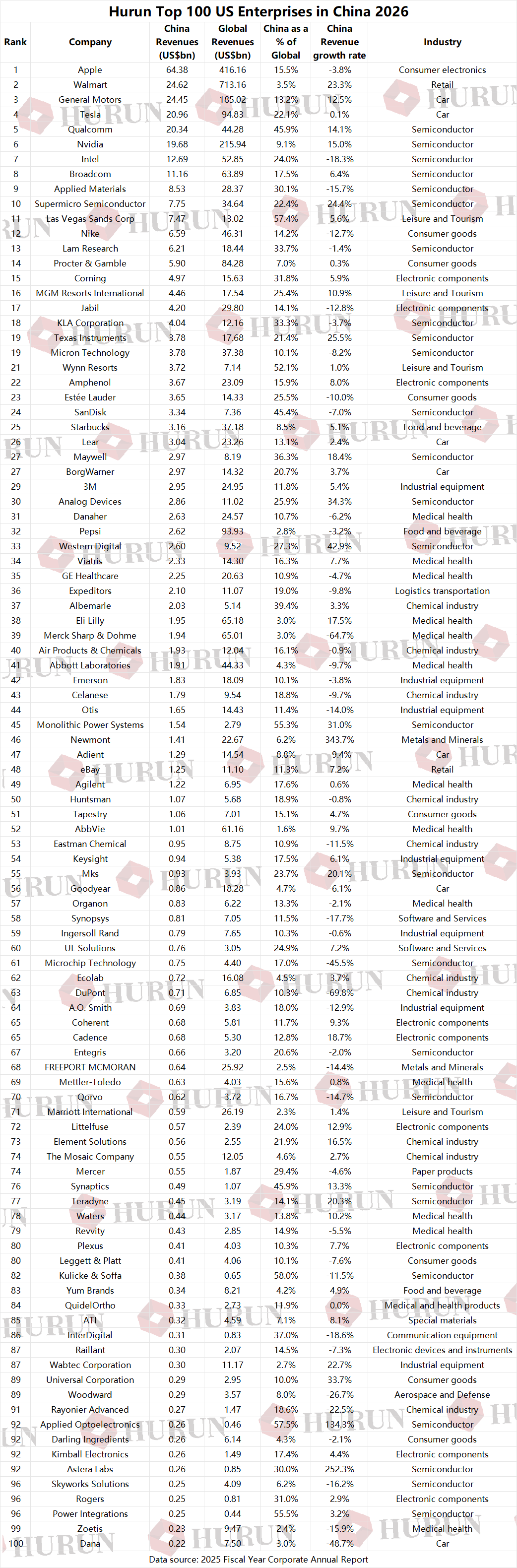
8 US companies have China sales of US$10bn or more, led by Apple with US$644bn and followed by Walmart, General Motors, Tesla, Qualcomm, Nvidia, Intel, and Broadcom.
6 US companies from the Hurun US 100 were part of the business delegation accompanying Trump on his recent visit to China, including Apple, Tesla, Qualcomm, Nvidia, Micron Technology, and Coherent.
(25 May 2026, Shanghai) Hurun Research Institute today released the “Hurun Top 100 US Enterprises in China 2026”. This report aims to track the performance of U.S. companies in the Chinese market. This is the third year of the report.
In 2025, 70,392 new foreign-invested enterprises were established nationwide, representing a year-on-year increase of 19.1%. The actual utilized foreign investment amounted to 747.69 billion RMB, a year-on-year decrease of 9.5%. Among these, the high-tech industry attracted 241.77 billion RMB in actual utilized foreign investment. Specifically, the e-commerce services sector, the medical instruments and equipment manufacturing sector, and the aerospace vehicles and equipment manufacturing sector saw increases of 75%, 42.1%, and 22.9% respectively in their actual utilized foreign investment.
U. S. President Donald Trump made his first visit to China in nine years last week, accompanied by a high-level American business delegation comprising prominent corporate leaders. The delegation included Nvidia CEO Jensen Huang, Tesla CEO Elon Musk, Apple CEO Tim Cook, as well as representatives from key U.S corporations such as Goldman Sachs, Blackstone, Boeing, and Cargill—companies spanning critical sectors including technology, finance, aviation, and agriculture. According to the criteria of the 2025 Hurun Global 1000, the total value of the participating companies included in the statistics was 104 trillion RMB, accounting for 13% of the total value of the Hurun Global 1000.
Chairman and Chief Researcher of Hurun, Rupert Hoogewerf, said:
“6 of Top 100 U.S.” Companies in terms of revenue in China had their top executives included in this business delegation accompanying Trump’s visit to China—namely Apple, Tesla, Qualcomm, Nvidia, Micron Technology, and Coherent. Together, these six companies generated total revenue of US$130 billion in China, equivalent to 880 billion RMB. “Specifically, Apple accounted for US$64.4 billion, Tesla for US$21 billion, Qualcomm for US$20.3 billion, Nvidia for US$19.7 billion, Micron Technology for US$3.8 billion, and Coherent for US$700 million.”
“The Hurun 100 U.S. Companies generated a total revenue of US$362.2 billion in the Chinese market in 2025. This represents more than the US$202bn trade deficit with China.”
“The Chinese market accounts for 12% of the revenues generated by the Hurun 100 U.S companies. Six of these companies derived more than 50% of their revenues from the Chinese market, including two Macao-based leisure and tourism enterprises: Sands Resorts and Wynn Resorts. From a corporate value perspective, the total market capitalization of these 100 U.S. Companies are US$19 trillion. Based on a revenue contribution rate of 12%, the Chinese market’s contribution to the market capitalization of these 100 U.S. Companies amount to as much as US$2.3 trillion, up 400bn since last year. I hope this report can help more people understand the ongoing strategic importance of the Chinese market to the U.S. businesses.”
“US semiconductor companies make up far and away the biggest number on the Hurun list, even occupying six of the Top 10 spots.” Among them, Qualcomm, Nvidia, Intel, and Broadcom each generated over US$10bn in revenue in China. Not only do semiconductor companies lead in the number of companies listed, but they also demonstrate strong growth momentum: Western Digital, Analog Devices, and AMD achieved rapid growth of 43%, 34%, and 24%, respectively, in China, underscoring the robust market demand for AI computing power, high-end chips, and the semiconductor industry chain in China.”
“Some of the U.S.” Companies on the list have seen a decline in revenues in China, which can be broadly categorized into two types: one group consists of companies facing the strong rise of Chinese domestic brands and intensifying market competition—for example, Nike in the consumer goods sector, Estée Lauder and Apple in the consumer electronics sector. Another group is influenced by industry cycles, with chemical companies such as DuPont and Rayonier Advanced, as well as automotive component manufacturers like Dana and Anderol, serving as examples.”
“In the most recent ‘Hurun Largest Foreign Companies in China’, there were more US companies than any other country, followed by Japanese and German companies.”
“Many will perhaps be surprised to know that the Hurun US 100 have been operating in China for an average of 32 years, led by the likes of Otis with 126 years, DuPont 109 years, and Eli Lilly 108 years.”
“’Going Global’ has become one of the hottest topics of conversation in China today.” The Hurun US 100 can be said to be role models for Chinese enterprises going global. Having come from the United States to China, they have contributed to the China economy by paying significant taxes, cultivating industry talent, and developing their China supply chain.”
Key findings of the report:
China was the second largest market for the Hurun US 100
Last year, the Hurun US 100 achieved total revenues of US$3 trillion worldwide, representing an 8.2% increase over the previous year and equivalent to 10.1% of the United States’ GDP. In China, their revenues came to US$362.2 billion, up 1.2%. Among them, 55 companies reported growth. Their China revenues remained stable at over 12% of their global total. For 48% of these companies, China is their second-largest global revenue market. Notably, eight companies reported revenues exceeding US$10 billion, with Apple continuing to lead the pack at US$64.4 billion in revenue.
Industry analysis:
1. Twenty-four companies from the mass consumption sector made the list, collectively generating US$184.5 billion in revenue in China, accounting for 51%. Two members of the visiting business delegation (Apple and Tesla) generated US$85.3 billion in revenue in China, representing 46% of the sector’s total revenue. Large consumer goods companies in the Chinese market are growing at a compound annual growth rate of 7.2%, matching the pace of the global market.
2. The Information Technology industry has 39 companies on the list, with total revenue generated in China reaching US$134.4 billion, accounting for 37%. Among them, the four members of the visiting business delegation (Nvidia, Qualcomm, Micron, and Coherent) generated US$44.5 billion in revenue in China, representing 33% of the industry’s total revenue.
3. Fourteen companies from the energy and chemical industries made the list, collectively generating US$13.5 billion in revenue in China, accounting for 4%.
4. Fourteen companies from the healthcare industry made the list, collectively generating US$18.1 billion in revenue in China, accounting for 5%.
5. Nine companies from the industrial sector made the list, collectively generating US$11.5 billion in revenue in China, accounting for 3%.
Who’s Growing?
The total market capitalization of the Hurun US 100 is US$19.6 trillion, up 26.2%, with 60% of enterprises seeing increases in their market capitalization. Among them, seven companies have seen their market capitalization double, led primarily by the information technology sector. Micron Technology, leveraging its leading-edge technologies and capacity focus in HBM (High Bandwidth Memory) and high-end enterprise storage, led the way, up 243%.
U.S. companies continue to invest in China, and technology cooperation and manufacturing hubs are taking root.
BorgWarner announced that it has successfully won a new project in China for the electric-drive electronic limited-slip differential (eXD), which will be integrated into electric-vehicle models manufactured by a leading Chinese automaker. Lear Corporation announced that its Lear (Chongqing) Seating R&D Center has officially signed an agreement to establish operations in Shapingba District, Chongqing. Agilent Technologies officially completed the construction of a new chromatography column manufacturing facility in Shanghai.
Apple makes the most sales in China.
Last year, Apple generated revenues of US$64.4 billion in China, and has 200 core suppliers, over 70% of which have factories in mainland China. Its supply chain is deeply integrated into China's manufacturing ecosystem, and China serves as its most important production base and growth engine.
Walmart’s second-largest China revenue
Last year, Walmart achieved revenue of US$24.62 billion in China. In 1996, Walmart opened its first Walmart Supercenter and Sam's Club in Shenzhen, one of the earliest foreign-invested supermarkets to enter the Chinese market. After 30 years of development in China, Walmart operates a variety of business formats and brands across the country and currently has hundreds of stores and over 20 distribution centers in more than 100 cities nationwide.
General Motors ranks third in revenue in China.
Last year, General Motors achieved revenues of US$24.45 billion in China. General Motors established a joint venture with SAIC Motor Group in 1997. Today, they are ‘established giants’ deeply entrenched in the Chinese market amid the electrification wave. Last year, General Motors delivered nearly 1 million new-energy vehicles in China, setting a new all-time high.
Tesla fourth
Last year, Tesla achieved revenues of US$20.96 billion in China. In 2018, Tesla signed a wholly-owned factory construction agreement with Shanghai Lingang, marking the beginning of ‘China Speed." Today, Tesla’s Shanghai Superfactory is not only the largest production base outside the United States—delivering 851,000 all-electric vehicles in 2025, accounting for more than half of the company’s global deliveries that year—but also boasts a localization rate for components exceeding 95%. Furthermore, Tesla’s second Shanghai factory began operations in 2025, officially entering the commercial energy storage business and continuing to deepen its industrial chain presence in China, thereby further strengthening Tesla’s integration with the Chinese market.
Qualcomm Fifth
Last year, Qualcomm achieved revenues of US$20.34 billion in China, accounting for nearly half of its total revenue, on the back of the expansion of Chinese mobile phone brands. In 2002, China Unicom introduced Qualcomm’s CDMA technology and built China’s first CDMA network. At the same time, Qualcomm’s collaboration with Chinese brands is now fully expanding into the automotive sector—for instance, Qualcomm has signed a deep cooperation agreement with Chery on intelligent cockpits, advanced driver assistance systems, and the integration of cockpit and driving functions. It provides Snapdragon Digital Chassis solutions for multiple high-end Chinese vehicle models. The Chairman of Qualcomm China has repeatedly stated that the company will deepen its localized collaboration in emerging fields such as 6G, AI, and embodied intelligence.
Nvidia Sixth
Last year, Nvidia achieved revenue of US$19.68 billion in China. Previously, Nvidia’s market strategy in China had been impacted by the U.S. export controls. However, during his visit to China, as reported by Reuters on May 15, U.S. authorities have officially approved 10 Chinese companies to procure Nvidia flagship AI chip, the H200. Additionally, Nvidia has established a new office in Shanghai focused on chip design and autonomous driving R&D, emphasizing that the Chinese AI market could reach hundreds of billions of dollars in size in the future and reaffirming its commitment to taking deep root in China.
Micron Technology
A global giant in memory and storage solutions, as demand for AI servers, data centers, and high-end computing power continues to grow, the strategic value of the storage sector is being reevaluated. In fiscal year 2025, Micron achieved revenues of US$3.78 billion in China. Although in 2023, China’s Cyberspace Administration issued a cybersecurity review result indicating that Micron’s products had failed to pass the assessment, and operators of critical information infrastructure in China were advised against procuring these products, Micron continued to invest in China in 2024, introducing entirely new production lines at its new plant in XiAn. Despite current constraints on expansion, Micron remains committed to sustaining its long-term service capabilities within China’s semiconductor ecosystem.
Coherent
Coherent is a global leader in optical communications and photonics technologies, primarily offering high-speed optical modules, optical chips, and laser devices. It is a key supplier for intra-data-center interconnects and AI cluster communications. In fiscal year 2025, Coherent achieved revenues of US$680 million in China, making China one of its top three single markets worldwide. In the Chinese market, Coherent mainly serves data centers of major internet companies through indirect channels, thereby indirectly supporting the massive demand for upgrading computing power clusters in China’s AI data centers.
Hurun Top 100 US Enterprises in China 2026
Methodology
The scope of the “Hurun U.S. Top 100 2026’ is based on US-based listed companies, which disclose their China revenues. Companies that did not disclose their China revenues but that ought to have made the list include companies like Coca-Cola, AIA Group, and Johnson & Johnson.
66 are constituents of the S&P 500 IndexTheir business performance in the Chinese market, as well as their views on and strategies for responding to US-China trade tensions, serves as valuable references.
This report draws on the Hurun Research Institute’s previous reports, including “2025 Hurun Global Top 1,000’ and ‘2026 Hurun Largest Foreign Companies in China’.
This is a brief translation of the original Chinese press release. For the full report, please visit Hurun’s official website at www.hurun.net to download it.
About Hurun Inc.
Promoting Entrepreneurship Through Lists and Research
Oxford, Shanghai, Mumbai
Established in the United Kingdom in 1999, Hurun is a research and media group, promoting entrepreneurship through its lists and research. Widely regarded as an opinion leader in the world of business, Hurun generated 8 billion views on the Hurun brand in 2025, mainly in China and India, and has recently expanded to the UK, the US, Canada and Australia.
Best-known for the Hurun Rich List series, telling the stories of the world’s successful entrepreneurs in China, India and the world, Hurun’s other key series focus on young businesses and entrepreneurs, through the Hurun Unicorns Index, two Hurun Future Unicorns indices, the Hurun Uth series and the Hurun Pioneers series.
Hurun has grown to become the world’s largest list compiler for start-ups, ranking over 3000 start-ups across the world through its annual Hurun Global Unicorns Index (startups with a valuation of US$1bn+), and two Hurun Future Unicorn Indexes: Gazelles, most likely to ‘go unicorn’ within three years, and Cheetahs, most likely to ‘go unicorn’ within five years.
The Hurun Pioneering Young Startups and Entrepreneurs series focuses on startups set up within the last ten years and founders aged 45 or under.
The Hurun Uth series includes the Under25s, Under30s, Under35s and Under40s awards, representing the cream of each generation of young entrepreneurs who have founded businesses with a social impact and worth US$1m, US$10m, US$50m and US$100m respectively.
Other lists include the Hurun 500 series, ranking the most valuable companies in the world, China and India, the Hurun Global High Schools List, ranking the world’s best independent high schools, the Hurun Philanthropy List, ranking the biggest philanthropists, and the Hurun Art List, ranking the world’s most successful artists alive today.
Hurun provides research reports co-branded with some of the world’s leading financial institutions and regional governments.
Hurun hosts high-profile events across China and India, as well as London, Paris, New York, LA, Toronto, Vancouver, Sydney, Luxembourg, Istanbul, Dubai and Singapore.
For further information, see www.hurun.net.
For media inquiries, please contact:
Hurun Report
Porsha Pan
Email: porsha.pan@hurun.net