2025 Hurun Global 1000
Today, the Hurun Research Institute and Shenzhen’s Futian District released the 2025 Hurun Global 1000, ranking the 1000 most valuable companies in the world. Companies were ranked according to their value, defined as market capitalisation for listed companies and valuations for non-listed companies. The cut-off date used was 14 November 2025. This is the sixth year of the list, and the second yea
2025 HURUN GLOBAL 1000
NVIDIA OVERTAKES MICROSOFT AND APPLE TO BECOME THE WORLD’S MOST VALUABLE COMPANY AT US$4.6 TRILLION, UP 49%, DRIVEN BY SURGING DEMAND FOR AI CHIPS AND DATA-CENTER COMPUTING.
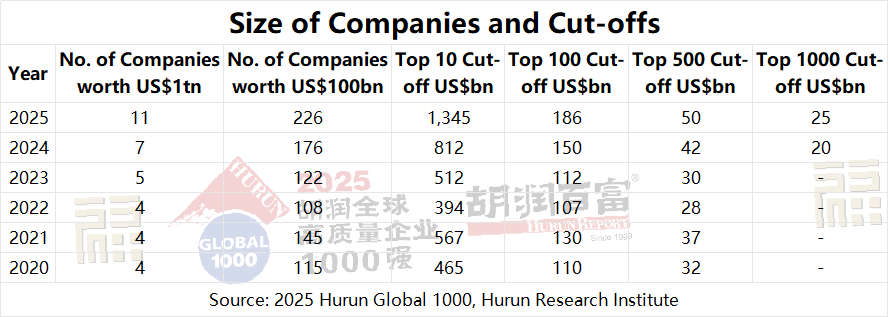
11 TRILLION-DOLLAR COMPANIES, UP FROM 7 LAST YEAR AND JUST 4 FIVE YEARS AGO. 9 FROM USA.
APPLE RETAINS SECOND SPOT WITH US$4 TRILLION, UP 23%, SUPPORTED BY STEADY DEMAND FOR ITS ECOSYSTEM AND STRONG SERVICES GROWTH.
LAST YEAR’S NUMBER ONE MICROSOFT DROPPED TO THIRD WITH US$3.8 TRILLION, UP 13%, REFLECTING STEADY MOMENTUM ACROSS ITS CLOUD AND ENTERPRISE BUSINESSES DESPITE LOSING THE TOP SPOT.
ALPHABET AND AMAZON ROUNDED OUT THE TOP 5, WITH ALPHABET ADDING US$1.1 TRILLION, UP 48% TO US$3.3 TRILLION, AND AMAZON UP US$525 BILLION, 26%, TO US$2.5 TRILLION.
SAUDI ARAMCO, THE ONLY STATE-OWNED COMPANY IN THE TOP 10, SIXTH WITH US$1.7 TRILLION, DOWN 8%, AS OIL PRICES DROPPED.
BROADCOM AND TESLA BROKE INTO THE TOP 10. BROADCOM WAS UP FOUR PLACES TO SEVENTH, SURGING 118% TO US$1.6 TRILLION, WHILE TESLA JUMPED THREE PLACES TO TENTH, UP 115% TO US$1.3 TRILLION.
USA LED WITH 410, FOLLOWED BY CHINA WITH 158 AND JAPAN WITH 63.
NVIDIA DELIVERED THE BIGGEST GAIN, ADDING US$1.5 TRILLION, FOLLOWED BY ALPHABET WITH US$1.1 TRILLION AND BROADCOM WITH US$877 BILLION.
NUMBER OF COMPANIES WORTH US$100 BILLION MORE THAN DOUBLES FROM 115 FIVE YEARS AGO TO 226 TODAY.
INDIA FOURTH EQUAL WITH UK, WITH 40, DESPITE DOWN 11.
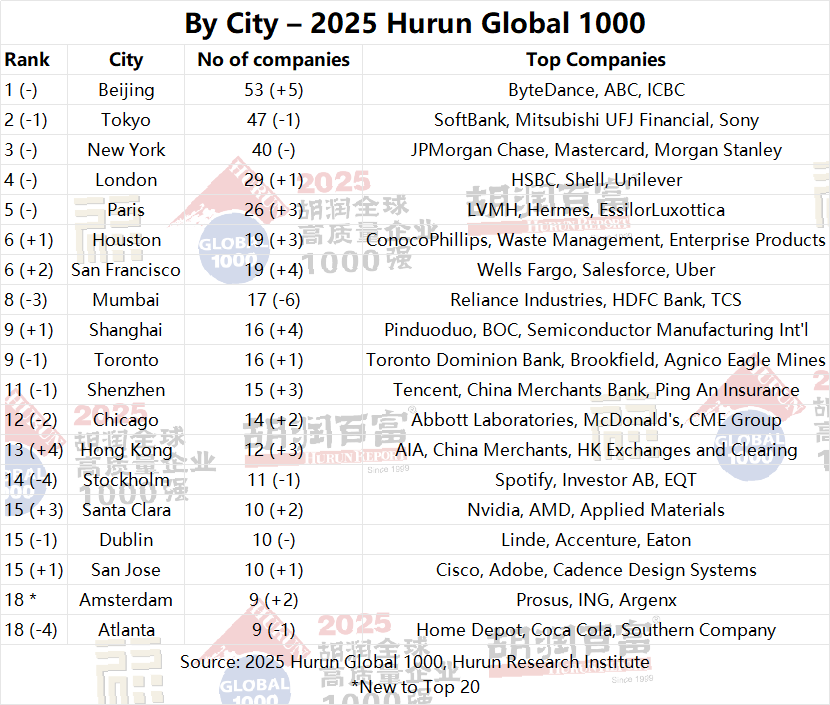
BY CITY, BEIJING, WITH 53, WAS TOP, AHEAD OF TOKYO WITH 47. NEW YORK THIRD WITH 40.
SHENZHEN WAS 11TH WITH 15, UP 3, OF WHICH 5 WERE IN SHENZHEN’S FUTIAN DISTRICT, LED BY CHINA MERCHANTS BANK, PINGAN INSURANCE, SHENZHEN METRO, CNG POWER AND HONOR.
BY INDUSTRY, FINANCIAL SERVICES LED WITH 249, FOLLOWED BY ENERGY WITH 119 AND HEALTHCARE WITH 73.
AVERAGE AGE 71 YEARS.
YOUNGEST. 12 FOUNDED WITHIN 10 YEARS, LED BY PINDUODUO AND ANTHROPIC WORTH OVER US$180BN AND XAI WORTH US$115BN. OTHERS INCLUDE CHINA-BASED SEMICONDUCTORS CAMBRICON AND MOORE THREAD, UK BANK REVOLUT, AS WELL AS COREWEAVE, SK SQUARE, ANDURIL, SAFE SUPERINTELLIGENCE, CURSOR AND ASTERA LABS.
16 HAVE LESS THAN 1000 EMPLOYEES, AND YET STILL MAKE THE CUT OF US$25BN. THE SMALLEST EMPLOYERS INCLUDE SAFE SUPERINTELLIGENCE, FOUNDED IN 2024 BY OPENAI COFOUNDER ILYA SUTSKEVER, WITH ONLY 20 EMPLOYEES, AND WORTH US$25BN, TELEGRAM WITH 30 WORTH US$30BN AND TETHER WITH 150 BUT ALREADY WORTH US$100BN.
WALMART LED WITH THE HIGHEST REVENUE AT US$681 BILLION, FOLLOWED BY AMAZON AT US$638 BILLION AND STATE GRID AT US$553 BILLION.
ALPHABET REPORTED THE HIGHEST PROFITS AT US$111 BILLION, FOLLOWED BY SAUDI ARAMCO AT US$105 BILLION AND APPLE AT US$96 BILLION.
IN CHINA, SHANGHAI WAS THE CHINA HEADQUARTERS FOR 286 OF THE NON-CHINA COMPANIES, FOLLOWED BY BEIJING WITH 114 AND HK WITH 19. IN INDIA, MUMBAI LED WITH 143, FOLLOWED BY BENGALURU 51 AND GURUGRAM 42.

(16 December 2025, Shenzhen city’s Futian district, China) Today, the Hurun Research Institute and Shenzhen’s Futian District released the 2025 Hurun Global 1000, ranking the 1000 most valuable companies in the world. Companies were ranked according to their value, defined as market capitalisation for listed companies and valuations for non-listed companies. The cut-off date used was 14 November 2025. This is the sixth year of the list, and the second year it was expanded to 1000 companies, up from 500.
79% of last year’s Hurun Global 1000 were up, of which 171 were new faces, and only 21% saw their value drop. The cut-off to the Hurun Global 1000 was US$25bn, up from US$20bn last year. Total value came to US$110.6tn. 62% sell physical products and 38% sell software and services. 42% sell directly to consumers, while 45% are B2B, and 13% serve both markets. By value, five industries make up half the Hurun Global 1000, led by Financial Services, Semiconductors, Software & Services, Energy and Consumer Goods. On average, they are 71 years old and are worth US$106bn, derived from sales of US$41bn and 82,000 employees.
90% were listed companies, with 10% non-listed, led by OpenAI, ByteDance and SpaceX.
Since the last list, the Shanghai Composite was up 17%, the S&P 500 16%, the NYSE Composite 12%, the FTSE 100 13%, EURO STOXX 50 12% and India’s Sensex 4%.
In that period, the US dollar depreciated against most major currencies in the world: down 7.3% against the Euro, 4% against the British Pound, 3% against the Japanese Yen and 0.1% against the Chinese Yuan, as well as down 15% against the Russian Ruble. The only major currency the US dollar was up against was the Indian Rupee, up 4%. Oil prices were down 8%. Bitcoin was up 66%.
Rupert Hoogewerf, Chairman and Chief Researcher of Hurun Report, said:
“If you want to understand the world economy, then the Hurun Global 1000 is the place to start. They are the backbone to the world economy. Between them, these 1000 companies had combined sales of US$41tn, roughly twice the combined GDPs of China and India, and employ 83 million staff, more than the working population of the UK and France combined.”
“The Hurun Global 1000 are the companies that investors believe are likely to generate the most profits going forward over the next ten or so years.”
“I would like to thank our partner Futian District in Shenzhen City. Futian District is well recognised as being particularly open to business to companies from all around the world. With five companies making the Hurun Global 1000, that is one third of Shenzhen’s 15. Were Futian to be a country, then it would make the Top 30 in the world!”
“AI technologies are accelerating the concentration of economic power. Big companies are getting bigger. We now have eleven trillion-dollar businesses on our list, up from just four in 2020. The value of the Top 10 has almost tripled to US$26tn, up from US$10tn in 2020, making them worth close to the entire stock exchange values of mainland China and HK combined. ”
“It has been another outstanding year for AI, led by Big Tech in the US, and a good year for Banks, Defense, Entertainment and Gold Miners.”
“AI value was being generated first in computing power, with the likes of Nvidia, Broadcom and TSMC surging ahead. Software was being led by Alphabet, Microsoft, Palantir, Oracle, Amazon as well as OpenAI and Anthropic. For devices, Apple, Samsung Electronics, Xiaomi and Sony led the way.”
“Deregulation and rate cuts under the Trump administration have combined to give large banks a great year, led by JPMorgan Chase, Morgan Stanley and Goldman Sachs. The bull market has added significant value to trading platforms, such as RobinHood and Interactive Brokers, as well as crypto exchanges.”
“Other sectors that have done well include Defense and Aerospace, led by SpaceX and Blue Origin; Entertainment, led by Tencent, ByteDance, Meta, Netflix and Spotify; Energy storage companies, led by China’s CATL, and utility providers; Pharmaceuticals, led by AbbVie with its new immunology medicines, Eli Lilly with its weight loss drugs and Gilead Sciences with its HIV drugs. Mining did well, especially gold miners.”
“By country, the USA continued to dominate, home to 40% of the Hurun G1000 and 57% of their total value. China was second with 158 companies, but adding 24 new faces, whilst the US was down 3. Between the US and China, they dominated with almost 60% of the list, showing why they are the two economic super powers of the world today.”
“India had a mixed year on the Hurun G1000, with only 40 companies making the list, down from 51 last year, mainly on the back of a weaker rupee against the US dollar. Large banks held their ground on the back of strong fundamentals.”
“311, up 2, or 62% of the companies in the Top 500 of the Hurun Global 1000, which is ranked by value, are not on the Fortune Global 500, which is ranked by sales. The likes of ByteDance, now worth US$480bn, did not make the Fortune list, but makes the Top 30 of the Hurun list. This reflects how value is shaped by forward-looking investor expectations rather than past revenues, changing as new information comes to light, such as elections, innovations, interest rates, inflation, government data, regulations, and economic confidence. Some companies had relatively small sales yet still made the Hurun Global 1000: San Francisco-based OpenAI had sales of less than US$3bn, yet has a valuation of US$500bn.”
“We now have the first wave of billion-dollar companies per employee, led by Safe Superintelligence, whose 20 employees generated a valuation of US$30bn, Telegram with 30 employees generated value of US$30bn and Tether with 150 employees has a value of US$100bn.Safe Superintelligence, Telegram and Tether have generated US$1bn in value for each employee they have. Unthinkable, even just a few years back.”
“14 companies from the Hurun Global 1000 are headquartered in countries different to where they started. By country of destination, Ireland led the way with 7 companies, followed by the USA with 3 and Switzerland with 2.”
“Value creation is changing rapidly. The best performer these five years, i.e., since Covid, has been Nvidia, which added US$4.3tn, followed by Microsoft, Alphabet, Apple and Broadcom, which all added over US$1tn. The worst performers were PayPal down just under US$200bn, two US-based telecoms companies Charter Communications and Verizon, down US$190bn between them, entertainment companies Walt Disney and Comcast down US$78bn and US$131bn, Koch Industries, down US$116bn, Nike, down US$115bn, and Pfizer, down US$71bn.”
“One in ten of the Hurun Global 1000 are not public companies. The most valuable companies in the world that have not yet gone public are led by OpenAI and ByteDance. Others of note include Robert Bosch, State Grid, Vitol, SpaceX, German retailers Aldi and Schwarz, as well as US energy giant Koch Industries and money managers Vanguard and Ares Management.”
Notably, this marks the second consecutive time that the Hurun Global 1000 has selected Futian as the venue for its release. This choice reflects a profound recognition of Futian’s internationalized business environment and industrial ecosystem, once again focusing global attention on this hub of premium enterprises. A total of five Futian-based companies made the list, accounting for 30% of Shenzhen’s total. The distinction of these companies not only highlights their core competitiveness but also reflects the solid foundation Futian provides for cultivating New Quality Productive Forces and nurturing high-quality corporate growth under its "CBD + Sci-Tech Innovation" development strategy.
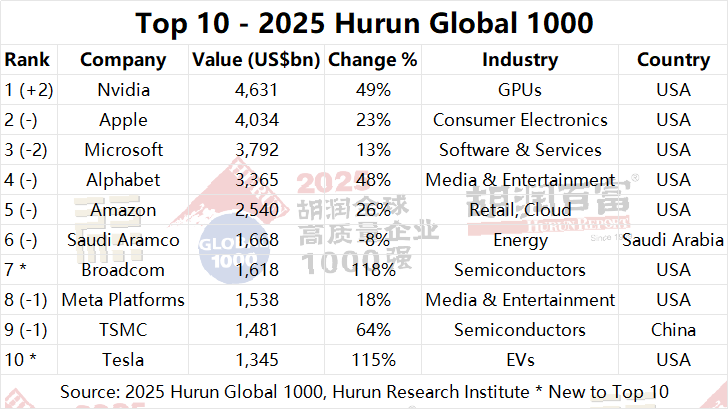
Global Top 10 Most Valuable Companies
The 2025 Global Top 10 is dominated by US tech giants, with Nvidia surging two places to top spot and a valuation of US$4.6 trillion after a 49% rise driven by unprecedented demand for AI chips. Apple retained second place at US$4 trillion, continuing to benefit from strong device and services revenue, while Microsoft slipped two spots to third despite growing 13% to US$3.8 trillion on the back of solid cloud and enterprise performance. Alphabet held fourth, jumping 48% to US$3.4 trillion, supported by rapid AI adoption and advertising strength, followed by Amazon in fifth at US$2.5 trillion after a steady 26% rise driven by e-commerce resilience and AWS growth.
Saudi Aramco remained the world’s most valuable energy company at US$1.7 trillion but fell to sixth after an 8% decline amid softer oil market conditions. Broadcom, a new entrant, soared 118% to seventh with US$1.6 trillion, reflecting the global semiconductor boom and increasing AI-related demand. Meta Platforms ranked eighth at US$1.5 trillion, sustained by strong engagement and AI-led monetisation, while TSMC followed closely in ninth after a robust 64% increase to US$1.48 trillion, driven by record chip manufacturing orders.
Tesla re-entered the Top 10, securing tenth place with a 115% surge to US$1.35 trillion, powered by strong momentum in EV adoption and deeper integration of AI across its product ecosystem. Overall, the list highlights how AI, semiconductors and cloud computing are reshaping global corporate value, with eight of the top ten companies rooted in advanced technology
Table 1: Top 10 - 2025 Hurun Global 1000
Where are they based?
Whilst the United States continued its dominance in the 2025 Hurun Global 1000, leading with 410 companies, down 3, China added 24 companies to keep second place with 158 companies. Between them, the US and China had 55% of the G1000.
Japan was third with 63 companies, adding two more this year, while India, Germany and the UK are tied in fourth with 40 companies each.
The West made up 62% of the 2025 Hurun Global 1000, led by the US with 410, the EU 160, Canada 38 and Australia 17.
The EU had 160 companies, led by Germany with 40, France 30, Sweden, Denmark and Finland with 26 and the Netherlands with 18.
South East Asia’s 11 countries had 18, led by Singapore with 7, Indonesia 6, Thailand 3 and Vietnam and Malaysia each with 1.
The GCC had 22, led by the UAE with 11, Saudi Arabia with 8, Kuwait 2 and Qatar 1.
By continent, Europe was third behind North America and Asia. Oceania, South America and Africa together made up only 3% of the Hurun G1000.
Table 2: By Country – 2025 Hurun Global 1000
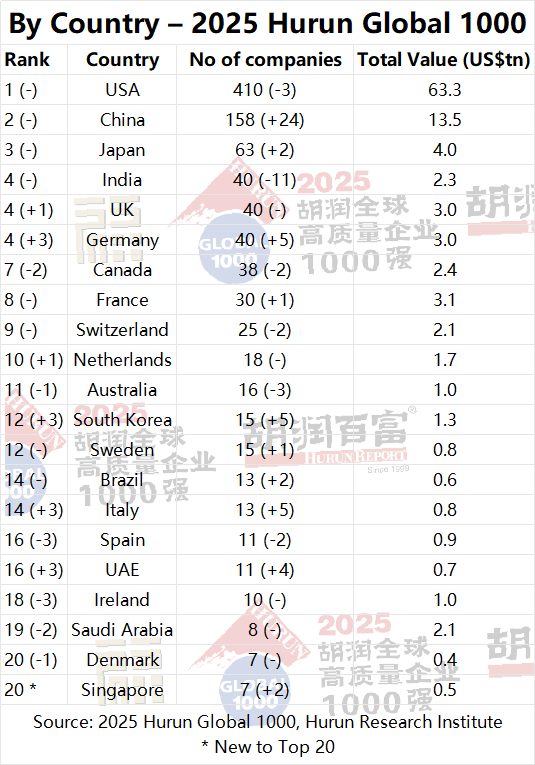
Table 3: By City – 2025 Hurun Global 1000
Of China’s 158 companies, 83 are state-owned and 75 are non-state-owned.
Table 4A: China Top 10 - 2025 Hurun Global 1000
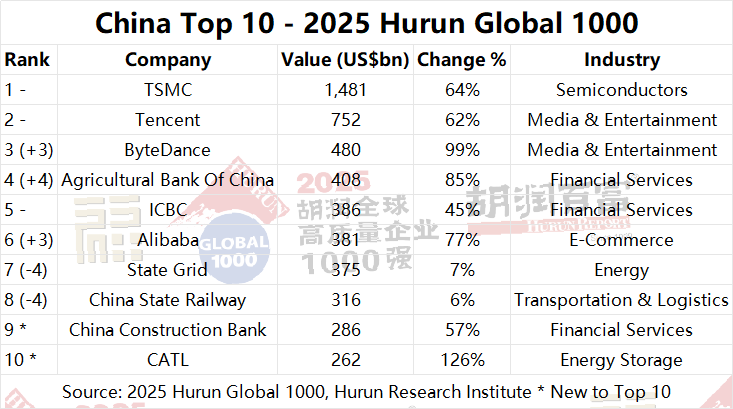
Table 4B: China By City – 2025 Hurun Global 1000
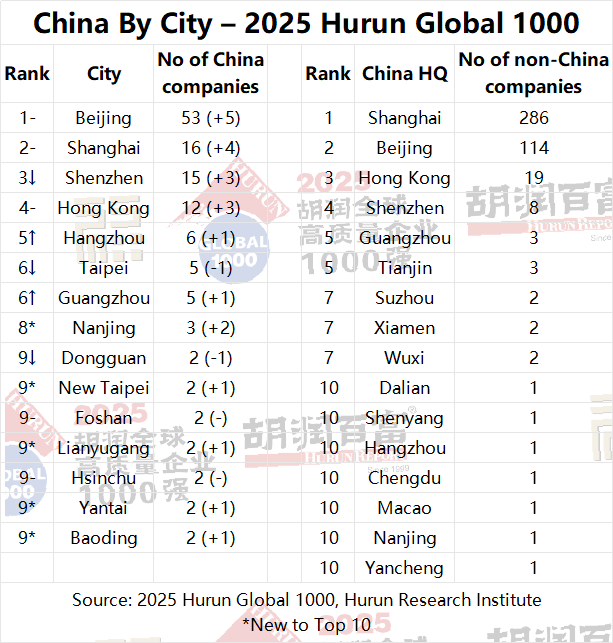
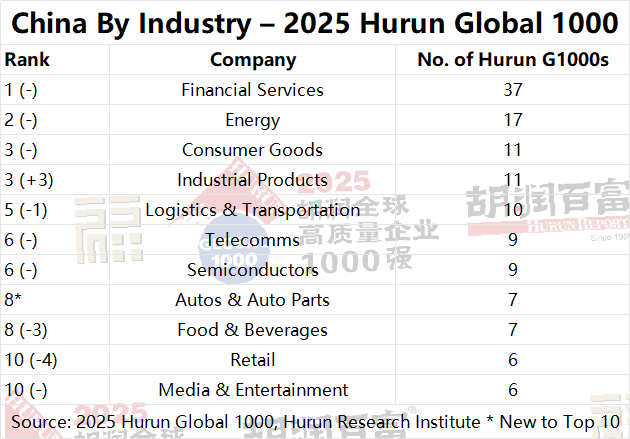
Table 4C: China By Industry – 2025 Hurun Global 1000
Top Gainers: Who’s on the Rise?
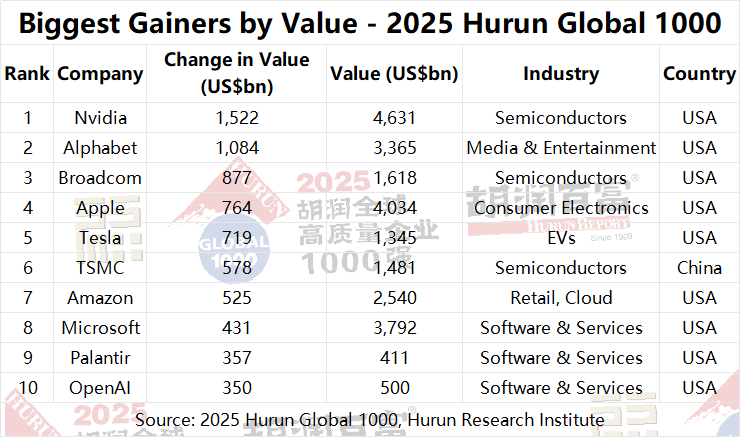
The biggest value gainers this year were Nvidia and Alphabet followed by Broadcom. Apple and Tesla each added over US$700bn, reflecting strong investor confidence in premium devices and EVs, as well as the potential for humanoid robotics.
Chip foundry TSMC and Amazon each increased by over US$500bn. Microsoft added over US$400bn, as demand for software and AI-driven services continued to grow.
Among specialised software and AI players, Palantir and OpenAI each added over US$300bn, underlining how AI platforms and data-driven software have become major engines of value creation.
For Financial Services it has been a good year. Deregulation and rate cuts under the Trump administration have combined to give large banks a great year, led by JPMorgan Chase. The bull market has added significant value to money managers, such as Blackstone and trading platforms, such as RobinHood and Interactive Brokers, whilst global deal making has helped investment banks led by Morgan Stanley and Goldman Sachs.
Other sectors that have done well include Defense, led by Aerospace giants SpaceX and Blue Origin, as well as defence technology giants Raytheon and Paris-based Safran; Entertainment, led by Tencent, ByteDance, Meta, Netflix and Spotify; Energy storage companies, led by China’s CATL, and utility providers; Pharmaceuticals, led by AbbVie with its new immunology medicines, Eli Lilly with its weight loss drugs and Gilead Sciences with its HIV drugs. Mining did well, especially gold miners.
For China, the best performer was TSMC, followed by Tencent, ByteDance, ABC and Alibaba.
Table 5: Biggest Gainers by Value - 2025 Hurun Global 1000
New Entrants
The new entrants that stood out were California-based trading platform Robinhood and USDt stable coin platform Tether, as well as Beijing-based semiconductor business Cambricon.
Table 6: New Faces - 2025 Hurun Global 1000

And who’s down?
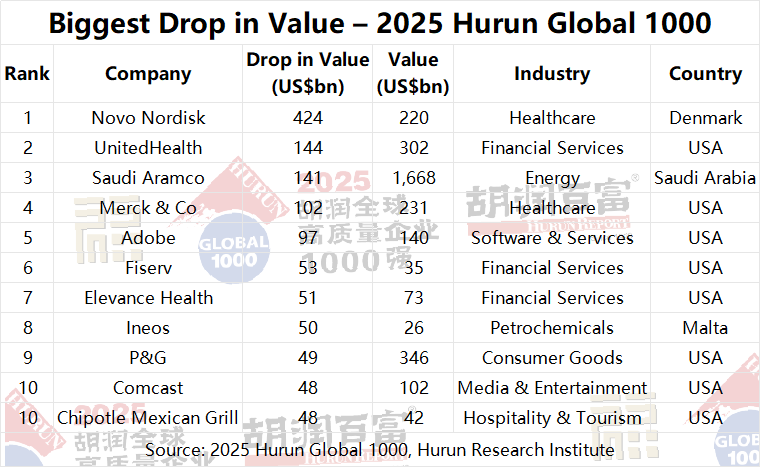
The largest drop in value was at Novo Nordisk, which shed two thirds or US$424bn of its value to end the year at US$220bn, reflecting cooling investor sentiment after years of rapid growth in its weight-loss drug portfolio. UnitedHealth saw its value fall by US$144bn, impacted by rising regulatory scrutiny and healthcare cost pressures. Saudi Aramco lost US$141bn, amid softer oil prices and weakening energy sector multiples. Adobe was down US$97bn or 41%, as bigger AI players overshadowed it.
For China, food delivery platform Meituan was the worst performer, followed by fast fashion platform Shein, China Guangfa Bank, medical equipment producer Mindray, Wanhua Chemicals and China Petroleum & Chemical.
Table 7: Biggest Drop in Value – 2025 Hurun Global 1000
Top Industries in Hurun Global 1000
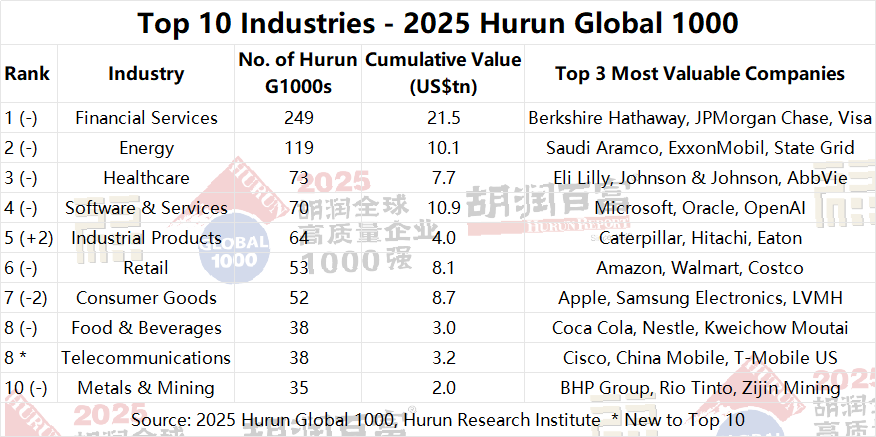
Overall, Financial Services led, followed by Energy and Healthcare.
Industrial Products and Telecoms both had good years, with Industrial Products climbing two places to fifth with 64 companies, led by Caterpillar, Hitachi and Eaton, and Telecoms breaking into the Top 10 with Cisco enjoying an especially strong year, as it ramped up its AI investments.
Table 8: Top 10 Industries - 2025 Hurun Global 1000
High Value, Lean Workforce
The Hurun G1000 includes a select group of ultra-lean companies creating enormous value with very small teams.
These were split into tech players, where three companies have now managed to generate US$1bn of value per employee, led by Safe Superintelligence, whose 20 employees generated a valuation of US$30bn, Telegram with 30 employees generated value of US$30bn and Tether with 150 employees has a value of US$100bn.
The others with high valuations and small number of employees include resource and holding companies, such as Vici Properties with 28 employees worth US$33bn, Wheaton Precious Metals and Franco-Nevada with only 41 and 49 people respectively, yet are worth US$49bn and US$39bn.
Table 9: Listed Companies with Least Number of Employees - 2025 Hurun Global 1000

Largest by Revenues, Profits and Workforces
On the other end of the scale are the revenue, profits and workforce giants.
By sales. Walmart topped the list as the world’s largest company by revenue, generating US$681bn, followed closely by Amazon with US$638bn and China’s State Grid with US$553bn.
By profits. Alphabet topped the global profit rankings with US$111bn, driven by strong digital advertising performance and rapid growth in AI-enabled services. Saudi Aramco followed closely with US$105bn, reflecting its dominance in the global energy market. Apple ranked third, reporting US$96bn in profit on the back of resilient demand for its premium devices and services ecosystem.
Microsoft generated US$93bn in profit, supported by cloud, enterprise software and AI-led expansion. Berkshire Hathaway posted US$89bn, maintaining its position as one of the world’s most consistently profitable conglomerates. Semiconductor leader Nvidia delivered US$73bn, reflecting unprecedented demand for AI chips and data-centre computing.
Among other major tech and financial players, Meta Platforms earned US$62bn, while JPMorgan Chase and Amazon each reported US$59bn, demonstrating the strength of the US banking and retail-tech sectors. Rounding out the Top 10, China’s ICBC posted US$52bn, standing as the most profitable financial institution outside the US.
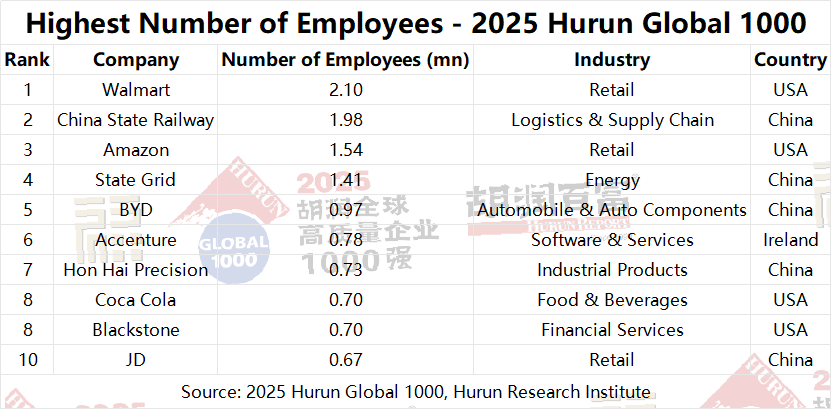
By workforce. Walmart remained the world’s largest employer with 2.1 million staff, followed closely by China State Railway, which employed 1.99 million people across its vast national transportation network. Amazon ranked third with 1.54 million employees, reflecting its large global fulfilment and logistics operations.
Table 10: Top Revenue Generating Companies: 2025 Hurun Global 1000
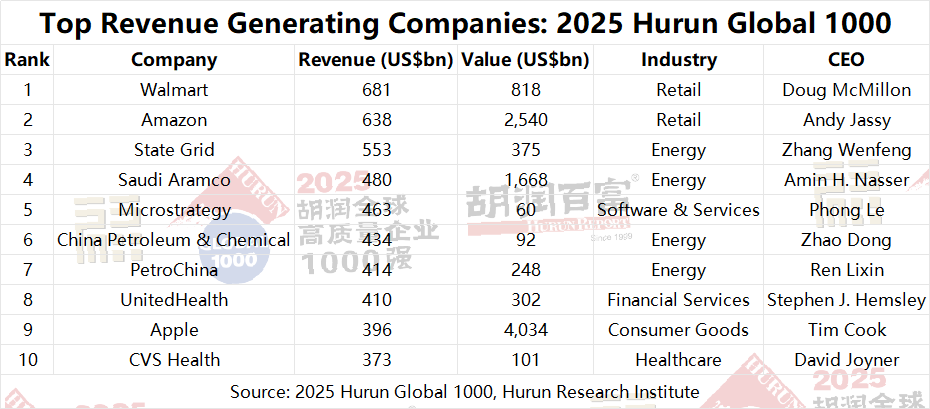
Table 11: Companies with Highest Profit - 2025 Hurun Global 1000
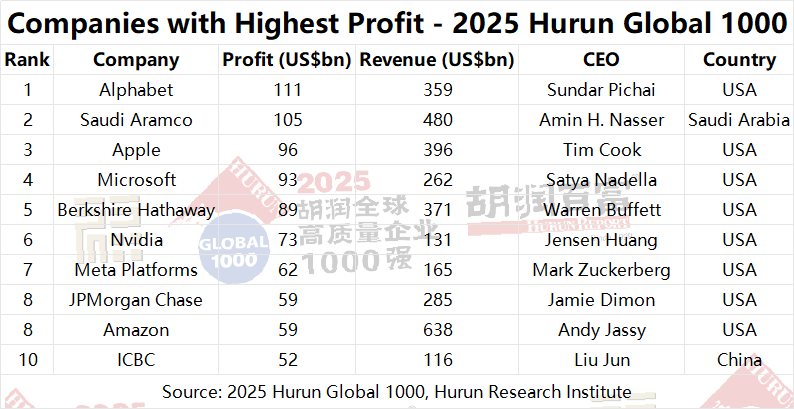
Table 12: Highest Number of Employees - 2025 Hurun Global 1000
Stats
Table 13: New Faces

Table 14: Size of Companies and Cut-offs
2025 Hurun Global 1000 Top 100

About Shenzhen city’s Futian district
As the core urban district of Shenzhen, Futian serves as the city’s primary hub for administration, culture, finance, commerce, and international exchange5. The district exercises jurisdiction over 10 sub-districts and 92 communities, spanning an area of 78.66 square kilometers with a permanent resident population of 1.5363 million.
In recent years, Futian has garnered significant recognition, including designations as a "Demonstration Area for the Safe China Initiative" and a "National Ecological Civilization Construction Demonstration Zone". In authoritative rankings by CCID Consulting, Futian ranked 1st in the "Top 100 Districts for Investment Competitiveness" and 2nd in the overall "Top 100 Districts". Furthermore, it secured the top spot in the "Pioneering Category" excellence rating under Guangdong Province’s "High-Quality Development Project for Hundreds of Counties, Thousands of Towns, and Myriads of Villages" (the "Baiqianwan Project").
I. Unique Strategic Location
Situated on the southern segment of Shenzhen’s central axis, Futian anchors the Shenzhen Central Business District (CBD) and is home to iconic urban landmarks such as the Civic Center, Lianhuashan Park, and the Ping An International Finance Center.
The district possesses unique cross-border advantages, hosting two major checkpoints (Huanggang and Futian Ports) and the No. 1 Channel of the Futian Free Trade Zone. With Futian High-Speed Railway Station as a transit hub, passengers can reach Hong Kong West Kowloon in just 14 minutes and Guangzhou South Station in 33 minutes, effectively creating a "Guangzhou-Shenzhen-Hong Kong 30-Minute Commuting Circle".
II. Robust Economic Fundamentals
In 2024, Futian demonstrated exceptional economic resilience:
l Gross Regional Product (GRP): Reached 594.882 billion yuan.
l Economic Density: Both GDP and tax revenue per unit area rank at the forefront of Guangdong Province and the nation.
l Consumption: Total retail sales of consumer goods stood at 160.316 billion yuan (down 3.3%).
l Trade: Total import and export volume reached 904.73 billion yuan (up 15.4%), ranking 1st among all districts (and counties) in Guangdong Province.
l Investment: Fixed asset investment totaled 68.4 billion yuan (up 10.1%), hitting a historic high.
l Fiscal Revenue: General public budget revenue was 19.399 billion yuan (down 6.6%).
l Livelihood: Per capita disposable income for residents rose to 107,685 yuan (up 5.8%).
Performance in Q1-Q3 2025:
The district continued its growth trajectory with a GRP of 471.173 billion yuan (up 9.3%) and general public budget revenue of 15.143 billion yuan (up 4.8%).
III. Prominent Industrial Advantages
l Financial Hub: Home to 301 licensed financial institutions (approx. 60% of Shenzhen's total) and 280 fintech institutions (approx. 70% of Shenzhen's total).
l Innovation Engine: Hosts the Hetao Shenzhen-Hong Kong Science and Technology Innovation Cooperation Zone, the only platform in the GBA Development Plan themed around tech innovation. Achievements from the International Quantum Academy were selected as one of the "Top 10 Scientific Advances in China".
l New Quality Clusters: Formed three "100-billion-level" industrial clusters in New Energy, Intelligent Terminals, and Software & Information Services (New Quality Productive Forces).
l Headquarters Economy: Home to 3 local Global 500 companies (30% of Shenzhen's total). One-third of Global 500 companies have established regional headquarters or branches in Futian.
IV. Pleasant Green Environment
Futian is advancing its "Green and Beautiful" ecological construction.
l Ecological Landmarks: The "International Mangrove Center," personally proposed and deployed by General Secretary Xi Jinping, has been officially inaugurated. The Futian Mangrove Ecological Park was among the first globally to receive the "Wetland Education Center Star Award".
l Livability: The district boasts a greenery coverage rate of 43% and houses 142 parks, essentially achieving a "500-meter radius park service circle".
l Environmental Quality: PM2.5 concentrations meet EU standards, and water quality across 27.65 km of rivers is rated excellent throughout.
V. Rich Livelihood Resources
l Public Services: The National Basic Public Service Standardization Pilot passed acceptance with the highest score in the nation and was listed as a "Typical Case of Comprehensive Pilot" by the SAMR, NDRC, and MOF.
l Education: Recognized as a "National Quality Balanced Development District for Compulsory Education" (first batch nationally, only one in the province). The district hosts 292 schools of various types.
l Healthcare: Home to 1,250 medical institutions, including 9 Grade-A Tertiary Hospitals.
l Culture & Sports: Features 25 major venues, including the Shenzhen Library and Concert Hall. Awarded "National Advanced Unit for Mass Sports".
l Safety & Stability: With an excellent safety environment, Futian was awarded the first batch of county (district) level "Peace Tripods" (Ping'an Ding) in Guangdong Province.
About Hurun Inc.
Promoting Entrepreneurship Through Lists and Research
Oxford, Shanghai, Mumbai
Established in the United Kingdom in 1999, Hurun is a research and media group, promoting entrepreneurship through its lists and research. Widely regarded as an opinion-leader in the world of business, Hurun generated 8 billion views on the Hurun brand in 2024, mainly in China and India, and recently expanding to the UK, US, Canada and Australia.
Best-known for the Hurun Rich List series, telling the stories of the world’s successful entrepreneurs in China, India and the world, Hurun’s other key series focus on young businesses and entrepreneurs, through the Hurun Unicorns and Hurun Uth series.
Hurun has grown to become the world’s largest list compiler for start-ups, ranking over 3000 start-ups across the world through its annual Hurun Global Unicorns Index (startups with a valuation of US$1bn+), and two Hurun Future Unicorn Indexes: Gazelles and Cheetahs, startups most likely to ‘go unicorn’ within three to five years.
The Hurun Uth series includes the Under40s, Under35s, Under30s and Under25s awards, representing the cream of each generation of young entrepreneurs who have founded businesses with a social impact and worth US$100m, US$50m, US$10m and US$1m respectively.
Other lists include the Hurun 500 series, ranking the most valuable companies in the world, China and India, the Hurun Global High Schools List, ranking the world’s best independent high schools, the Hurun Philanthropy List, ranking the biggest philanthropists and the Hurun Art List, ranking the world’s most successful artists alive today.
Hurun provides research reports co-branded with some of the world’s leading financial institutions and regional governments.
Hurun hosts high-profile events across China and India, as well as London, Paris, New York, LA, Toronto, Vancouver, Sydney, Luxembourg, Istanbul, Dubai and Singapore.
For further information, see www.hurun.net.
For media inquiries, please contact:
Hurun Report
Porsha Pan
Email: porsha.pan@hurun.net